
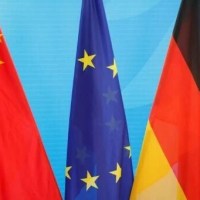

Navigating Economic Waters: Germany’s Challenges in a Competitive China
China has long been a lucrative market for German enterprises, fueling a boom that significantly bolstered the eurozone’s largest economy. From high-end automobiles to sophisticated manufacturing equipment, the insatiable demand from the Asian giant plays a crucial role in Germany’s economic narrative. However, this dynamic is shifting markedly, and German businesses now face an evolved landscape fraught with increasing competition.
The Changing Market Landscape
As Chinese industries advance in high-tech sectors, Germany’s former stronghold is seeing its profits squeezed. The significance of the Chinese market for German exports remains, but the relationship has morphed into one where competition from China is increasingly formidable. For instance, the CEO of 4JET, Joerg Jetter, highlighted this transformation from a "very attractive market" to a "very capable competitor," particularly in pivotal areas like automotive and mechanical engineering. 4JET, headquartered in Alsdorf, southwestern Germany, is indicative of many German companies feeling the pinch as local competition becomes more pronounced.
A Shift in Strategy
The founder of 4JET, with its focus on industrial laser processing technology, has experienced firsthand the ramifications of China’s industrial ascent. Once reliant on selling advanced machines to China’s solar cell sector, Jetter pivoted to licensing his technology to local firms rather than competing directly. This shift underscores a broader trend within the German industrial ecosystem: as competition in China intensifies, companies are reevaluating their strategies to safeguard their market position.
The Strain on Small and Medium Enterprises
While global automotive titans like Volkswagen may grab headlines as they grapple with unparalleled competition from Chinese automakers, smaller and medium-sized companies—the backbone of Germany’s economy—find themselves facing harsher realities. Experts like Oliver Richtberg from the VDMA, an association representing around 3,500 factory equipment firms, confirm that the anticipated "China shock" is manifesting. With approximately 90% of VDMA members employing fewer than 250 employees, many worry about their capacity to compete effectively.
Hard Data Reveals Economic Shifts
Statistics reveal the stark transformation in trade dynamics. In 2025, German exports to China plummeted by 9.3%, while Chinese exports to Germany have surged. A record trade deficit of approximately 89 billion euros is a jarring wake-up call for German industry. Observers trace this evolving competition back about a decade, pinpointing China’s aggressive rise in high-tech manufacturing, bolstered by significant state subsidies, as a pivotal factor.
Calls for ‘De-risking’
The growing competition from China has raised concerns about the balance of economic relations between China and Europe. Voices advocating for businesses to "de-risk" increasingly stress the need to diversify into other markets. Particularly, this has become essential following China’s tightening grip on exports of critical materials like rare earth minerals, as well as halting semiconductor exports that alarmed the German automotive sector.
Perceptions of the ‘Made in Germany’ Label
In the past, the "Made in Germany" label carried a reputation for quality and reliability. However, many firms now believe that this prestigious brand is losing its luster. Executives like Egbert Wenninger from Grenzebach point out that perceptions of Germany and Europe have shifted. Instead of being seen as leaders in innovation, they are now sometimes viewed as "slow, bureaucratic, complicated, and expensive." Despite this, Wenninger notes that his company has managed to maintain its market share in China, showcasing a complex relationship that blends challenges with opportunities.
The Balancing Act Ahead
As Chancellor Friedrich Merz prepares for his inaugural visit to China, navigating these complexities will be a focal point. While strengthening Germany’s economic ties remains crucial, he is also under pressure to address concerns about unfair trade practices in China. Jetter believes that Merz’s visit represents a pivotal moment where Germany can affirm its commitment to a rules-based, free market economy, advocating for a level playing field that insists on fair competition between equal partners.
In this evolving landscape, the balancing act between competition and collaboration will play a determining role in shaping the future of German industry in the global arena.