
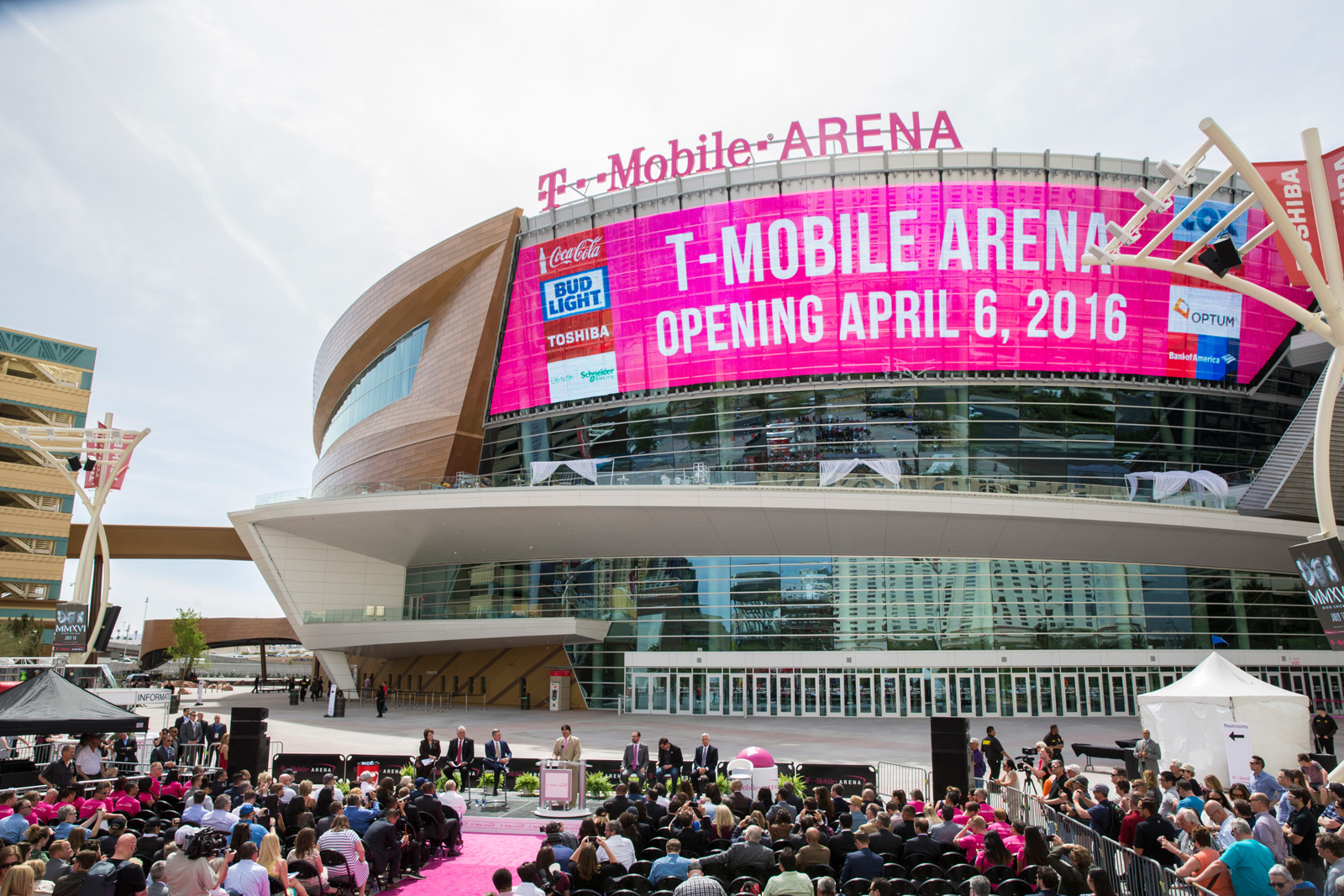

Time for a Vegas trivia question. Who was the first performer at T-Mobile Arena?
If you answered the Killers, sorry, close but no cigar. The Vegas-born band headlined opening night on April 6, 2016, but Wayne Newton took the stage before they did. The concert opener and correct answer: then 21-year-old indie pop artist Shamir, who was born and raised in North Las Vegas.
And if you thought it was a trick question and instead answered the Vegas Golden Knights were the first to play at T-Mobile, or thought a UFC mega fight was the debut event there, you get a bonus point. You’re still wrong, but you clearly understand what makes this wildly successful venue so special compared to the many other temples of entertainment in this city.
Dan Beckerman, president and CEO of global entertainment house AEG since 2013, made a seemingly hyperbolic statement when T-Mobile Arena opened 10 years ago next month, but it came true: “We believe that this venue is going to transform the entertainment business in Las Vegas forever.”
As co-owner and sales agent of the arena, of course AEG was all in, as was the other owner, MGM Resorts International. With a max capacity of 20,000 seats and a Strip-side location wedged between MGM casinos New York-New York and Park MGM, it was a bit bigger than the MGM Grand Garden Arena or the Thomas & Mack Center, and certainly more modern, arriving more than 20 years after the Grand Garden.
But it wasn’t just an upgraded alternative. T-Mobile Arena was always intended to transform the industry by bringing different music, sports, and other types of events that otherwise wouldn’t have come to or stayed in Las Vegas, most notably the first major league franchise to call Vegas home.
That just happened to be the National Hockey League’s Golden Knights, but hypothetically, it could have been a National Basketball Association team. The arena was built for both options. The NHL was ready to expand. The arena helped open the door and Texas-born businessman Bill Foley walked through it.
The way our hockey team played and connected to the community is another story, one that’s been told many times in many ways since the Golden Knights first took the ice. But their home, the Fortress, is also the first real home for locals on the Strip. This sports arrival brought at least 41 opportunities every year for Southern Nevadans to come together and support something that felt like ours, and to do it on the relatively small part of Las Vegas that is decidedly not ours.
“We knew we had to deliver something that locals as well as tourists around the world would be proud of,” then-MGM Resorts CEO Jim Murren said at the grand opening. “I can tell you when you visit this arena tonight, and any night, you will say there’s no better arena, no better venue in the world.”
Plenty of VGK fans feel that way, and now that we’re a decade in, perhaps we can appreciate how magical it is that an arena single-handedly shifted the old cliché that Las Vegans don’t go to the Strip.
And the Fortress is only part of the experience at T-Mobile. It is and always has been the home of UFC. Countless big concerts have come through, from Kendrick Lamar to Fleetwood Mac, and it’s consistently ranked as one of the top-grossing venues in the world, yet it’s not as busy as other arenas of its size.
“We designed it to be as flexible as possible because we wanted to be not only busy, but have diversity in programming. We never wanted logistics to be an obstacle that keeps us from going between a concert to a hockey game to a UFC event,” says Dan Quinn, senior vice president of entertainment and arena venue operations for MGM Resorts. “We’ve had some pretty crazy consecutive events, gone from ice to dirt with [Professional Bull Riders] events in a day or two. But we can do it all and have done it all.”
Quinn has been at T-Mobile Arena before it existed, joining the development and construction team after working at arenas at Mandalay Bay and MGM Grand. While stretches like this month’s hockey game to Peso Pluma concert to another hockey game in three days makes the arena feel absolutely stacked, the strategy remains focused on building programming around weekends to capitalize on tourist traffic, he explains.
“It’s market-specific, the uniqueness of Vegas,” Quinn says. “We’re a little less busy [than other similarly sized arenas] in total events and we’re not usually hosting events on Tuesday or Wednesday.
“We are pretty rare with what we do in the ticket sales we drive, and that keeps us in that higher echelon. We are spoiled by the special event programming we’re able to do here. A lot of markets have to fight to have a UFC event every four years, and here we are with this embarrassment of riches, four UFC events a year and the biggest boxing matches in the world.”
The design of T-Mobile Arena has also been a key to its success, one that’s easily overlooked. The exterior low profile blends in behind the towering resorts on the south Strip, and while it sits on a relatively small footprint for a building of its scope and capacity, the feeling inside is one of openness and accessibility. It has only one level of suites with special seating when other arenas of the same generation have two or three, but scarcity has proven valuable.
“Other arenas have a lot of corridors and closed spaces. We wanted to keep everything vertical and open because having that kind of space transforms the way you feel in the venue,” Quinn says.
How many big moments have been had here? Floyd Mayweather Jr. versus Conor McGregor. A historic residency from country legend George Strait. The Vegas Strong Benefit Concert in December 2017 featuring Imagine Dragons, the Killers, Boyz II Men, Penn & Teller, and lots of tears and hugs. The hard-to-describe feeling of gathering outside in Toshiba Plaza waiting to watch the Golden Knights play a home game in the Stanley Cup Final in their first season.
Even though it’s not the biggest or most modern venue in the vicinity of the Strip anymore, no single building has had the same kind of impact on how Las Vegas brings people together. T-Mobile Arena has transcended the previous model of building a bigger, better casino resort to draw visitors to the desert.
On the other side of the coin, it also brought about the demise of free casino parking, but that was likely inevitable if you believed major league sports were always going to land in Las Vegas at some point. The Raiders and the A’s felt they needed to also be on the Strip, or as close as possible, once T-Mobile and the Golden Knights served as proof of concept.
Maybe in five or eight years we’ll be writing that Allegiant Stadium or Sphere is actually the venue that changed everything, but I doubt it. In some ways, the city was overdue for a place that could do all these things, and in other ways, T-Mobile Arena was the perfect solution at the exact right time to help Vegas take the next big step.
And it’s only been 10 years. Imagine how many big moments are still coming.
Click HERE to subscribe for free to the Weekly Fix, the digital edition of Las Vegas Weekly! Stay up to date with the latest on Las Vegas concerts, shows, restaurants, bars and more, sent directly to your inbox!