

In the latest developments surrounding the Las Vegas Raiders, the franchise has reportedly set its sights on Seattle Seahawks offensive coordinator Klint Kubiak for their head coaching position. Recent meetings between Kubiak and Raiders representatives indicate mutual interest, enhancing the notion that he could be the next head coach. While the Raiders are unable to officially hire Kubiak until after the Super Bowl, the dinner held on January 31st suggests a strong rapport between the two sides. Kubiak has earned his reputation as a highly creative play-caller, adept at employing intricate play designs and a heavy reliance on RPO (Run-Pass Option) concepts, which may be just what the Raiders need.
Quarterback Fernando Mendoza:
Under Kubiak’s system, RPOs help to create opportunities for yards after catch (YAC) while compelling defenses to remain wary of a deep passing threat. This approach aligns well with quarterback Fernando Mendoza, who has displayed a knack for high YAC plays and quick-hitting passes from his time at Indiana. Mendoza’s ability to throw in rhythm with excellent footwork complements Kubiak’s pre-snap concepts beautifully. Both quarterback and coach share a Philadelphia-style preference for striking within the 8-12 yard range, making Mendoza a promising fit for Kubiak’s offensive initiatives. However, for Mendoza to thrive, a solid supporting cast will be essential—something rookie quarterbacks typically rely on.
Running Back Ashton Jeanty:
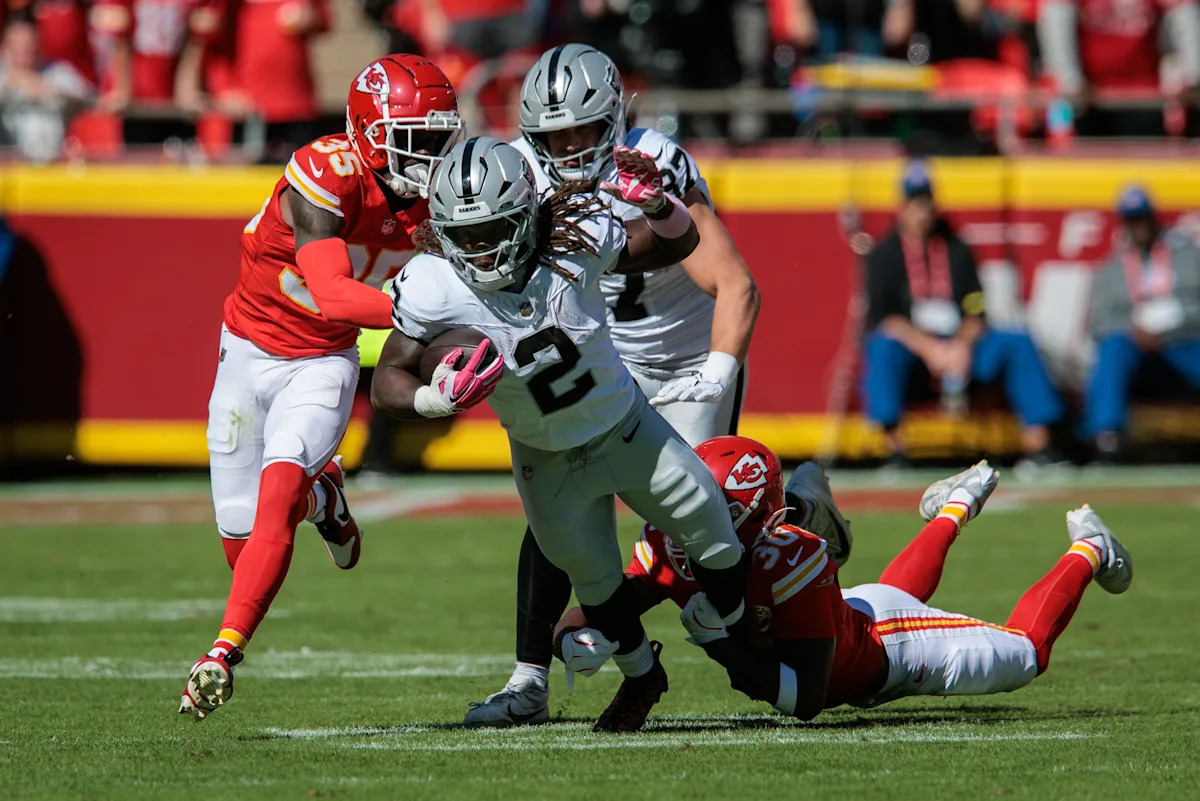
As a traditional wide zone running back, Ashton Jeanty has been successful at Boise State and showed promise with the Raiders during limited opportunities. He averaged 4.25 yards per carry within a similar wide zone concept. Kubiak emphasizes a patient rushing game that leverages offensive linemen and tight ends to set up crucial blocks, allowing runners to find the holes for consistent gains. Jeanty’s quick first step and ability to handle contact are ideal traits that fit into Kubiak’s rushing scheme. It’s likely that the Raiders will need to add another running back to implement a two-back system, similar to Kubiak’s frameworks used in New Orleans and Seattle, while also tapping into Jeanty’s receiving abilities.
Tight End Brock Bowers:
Brock Bowers represents another dynamic potential addition. In past offenses, Kubiak has used players like Jaxon Smith-Njigba as versatile “joker” receivers, exploiting their varied alignments to create mismatches. Bowers has extensive experience lining up in different positions, allowing him to capitalize on YAC opportunities effectively. With the Raiders, Bowers could become a focal point of the offense, projecting potentially over 1,200 yards if utilized cleverly in Kubiak’s diverse schemes.
Tight End Michael Mayer:
Kubiak also has a track record of employing tight ends extensively, utilizing them in various offensive formations. Michael Mayer, who presents a solid blend of blocking and receiving skills, fits Kubiak’s archetype. Mayer could serve as a key asset in the wide zone running game while also complementing Bowers’ versatility, especially in high-pressure offensive situations.
Wide Receiver Tre Tucker:
Tre Tucker has the speed and versatility to thrive in Kubiak’s schemes. His ability to create vertical threats and use pre-snap motion effectively works well within Kubiak’s system. Though he may play a smaller role as a secondary receiver, the potential for YAC opportunities and sideline routes could allow Tucker to carve out a meaningful role.
Wide Receiver Jack Bech:
Jack Bech is a young talent who could fit the mold of Kubiak’s big slot receivers. With experience resembling that of Ceedrick Wilson and Cooper Kupp, Bech excels in the 7-10 yard range, making him a valuable asset in short-to-intermediate passing. His growing role could position him as a reliable point of reference for the offense, akin to Kupp in Kubiak’s previous schemes.
Offensive Line Considerations:
While the Raiders’ offensive line certainly has room for improvement, some current members possess qualities that can align well with Kubiak’s wide zone system. Left tackle Kolton Miller has previously demonstrated his effectiveness in this scheme. Currently, guard Dylan Parham stands out as a potential asset, especially if he shifts toward right guard, leveraging his space-work ability. Center powers-Johnson, who ran a similar scheme in college, may be an ideal fit, although it’s possible a veteran center could complement his growth. Meanwhile, players like DJ Glaze, Charles Grant, and Caleb Rogers demonstrate potential that could gel well with Kubiak’s vision for an offensive line bolstered through athleticism and synergy.
Other Notable Names:
WR Dont’e Thornton Jr
Though still on the journey to becoming an impactful player, Dont’e Thornton possesses speed that may be used strategically for design plays or short catches to maximize his YAC capability. While his route running needs refinement, he can still become a valuable rotational asset.
TE Carter Runyon
Carter Runyon may not see extensive playtime but possesses the size and athletic ability to be a solid rotational tight end. His capacity for blocking and potential for snagging quick receptions can support Kubiak’s multi-faceted offensive philosophy.
WR Shedrick Jackson
A surprising name, Shedrick Jackson boasts exceptional speed and the ability to create separation, fitting perfectly within Kubiak’s system that maximizes route efficiency. Plus, there’s intriguing potential for utilizing him in special teams due to his kick-return history.